Showing posts with label Naga and Its People. Show all posts

26 May 2011

May Pag-asa o wala? You be the judge

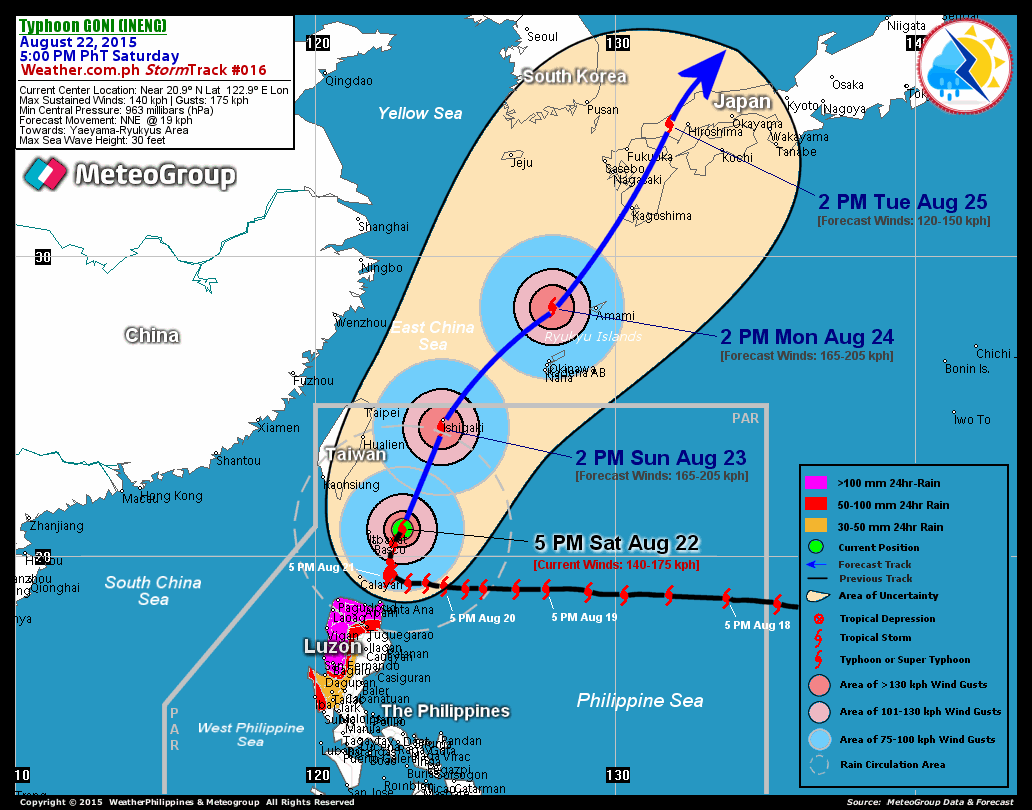
BELOW is the tracking taken from Pagasa's 5 AM weather bulletin:


PAGASA

Now compare that with the trackings below prepared by Mike Padua's Typhoon2000.ph, the US Joint Warning Center (JTWC) and the Japan Meteorological Agency (JMA), respectively:


 Typhoon2000.ph


 JTWC


 JMA

I think the national weather bureau does not inspire confidence.

More...

26 March 2011

A homecoming — for someone who never left

Commencement Speech, 63rd Commencement Exercises, UNC High School, March 26, 2011.

I’M HONORED to address the 2011 Graduating Class of the University of Nueva Caceres in this most important occasion in your student life. I can certainly say I understand the mixed feelings that go with the occasion, having been in your shoes 25 years ago.

Which is quite something, isn’t it? After all, our batch, UNC High School Batch ’85, was the last of the so-called “Marcos babies”: in bidding goodbye to high school life on March 30, 1985, we were the last of our kind to graduate with the late dictator Ferdinand Marcos as sitting president.

Less than a year later, a snap election would be held on February 7, 1986, pitting Marcos against Cory Aquino, the widow of opposition Sen. Benigno Aquino, Jr. who was assassinated two years back in August 1983 — when we were still in third year high school, in our classroom there in the Engineering Building. It would be the beginning of the end. In two weeks time, the People Power Revolution would take place in Edsa and sweep the Marcoses out of power. And the rest is history.

Yet, all these would probably be unimportant to you, as a generation who grew up on gadgets like the ubiquitous cellphone that cannot be separated from your body, or social networking technologies like Facebook and Twitter that bind groups and communities together. I will not be surprised if for most of you, the Edsa Revolution of 1986 — whose 25th anniversary the country celebrated this year — is only stuff of textbooks, a boring but required reading to get you through school. (Although nowadays, you can also google it on the internet and download commemorative video clips on Youtube, something we didn’t have back in our days.)

But boy, were they tumultuous years for our generation, those four we spent at UNC High! Looking back from hindsight two and a half decades later, I still cannot figure out how my parents, an ordinary farmer and a plain housewife from Sagrada, Pili, were actually able to send me and my brother (who is two years my junior) to UNC. Most probably it was because they’re into farming that our family livelihood was mostly shielded from the tremendous economic difficulties of the time. Moreover, many farmers have no choice but to continue farming, because they actually don’t have any other option available.

Nonetheless, this singular opportunity to speak before you, as a “young once,” I therefore owe them. In the same manner that your presence here must have been made possible by having parents, guardians or benefactors by your side. But that is not what I want to dwell on today.

Nowadays, it’s easy to lose hope, especially in these difficult times. For someone who has practically seen our country swing from the extremes — from a repressive regime under Marcos to a restored democracy under Cory, from the dull but gung-ho days of Ramos and his technocrats to the false populism of Erap and his midnight cabinet, followed by yet another People Power uprising in 2001 (and a planned coup d’etat by military backers, just in case) that installed Gloria Macapagal-Arroyo and her regime of broken promises, which left in its wake equally broken democratic institutions, and now another Aquino back in Malacanang, propelled by the Biblical metaphor of “tuwid na daan” — I would like to think I’ve seen it all.

It’s as if the country has just wasted a quarter of a century hurtling from one crisis to another, fighting and containing fires of our own making, so much so that 25 years later, our democracy project remains a largely unfulfilled promise. Meanwhile, our neighboring countries in Southeast Asia have gotten their act together, moved on and sped ahead — iwinalat na kita sa baybayon.

It pains me because I am reminded of, and now feel chastised by that vigorous debate I had with a lovely lady at the Provincial Capitol, where, fresh out of college, I worked from 1989 to 1991. It came during the time Gringo Honasan and his RAM cohorts have just launched another coup against Cory Aquino — I think it was the one that almost killed Noynoy. The Capitol lady, clearly talking from experience, opined that she doesn’t anymore care if Cory is ousted; it’s all about power, and whoever wins, it’s the country that actually loses. I, on the other hand, passionately argued that the newly restored democracy will weather these challenges and a better future awaits us because we will have learned from the lessons of history.

It turns out I am both right and wrong. Right that Cory would survive the coups, and eventually exited the presidency with the grace and goodwill her successors never had. But I was terribly wrong about the more important thing — we cannot seem to learn from history.

And she was right on what really matters most — it is the country that loses. Filipinos do not seem to have what it takes to succeed as a nation. Other countries have snatched victory from the jaws of defeat, and bounced back when they fall down. We, on the other hand, don’t seem to know how to win, which starts with getting our act together under a president who can inspire and draw the best from every Filipino. We instead revel in our infinite capacity to laugh at our own misfortunes, mistaking it for the legendary resiliency of the bamboo. But repeated many times over without ever learning, these are really failings that bite, very much like that ancient Bee Gees song called “I Started a Joke” that is probably alien to your Lady Gaga-Taylor Swift-and-Justin Bieber generation. Even then, these failings are no longer funny — because mothers are dying during childbirth; children are growing hungry and stunted, eventually dropping out of school; our population is exploding; and poverty continues to prey on our benighted land.

But there is hope, because there is a better way. What our batch did is probably instructive — we simply ignored the national government and moved on with our lives. Like many Filipinos today, a number chose to vote with their feet and went abroad. Many of them are doing well. In a decade or so, they should be coming home and contribute more directly to community building. Others chose to leave and try their luck in other places of the country, including Metro Manila. But most opted to stay in Bicol, particularly in Naga, like myself and many others who have built their family, career and living in this city we call “maogmang lugar.”

The bottomline is this: We have cut off the static and the crap that came from a central government and its parade of post-Edsa administrations that have failed miserably, and upon which we have very little influence — and decided to rechannel our energies to more productive pursuits.

This process is called re-centering. Here, I take a leaf from literature, by way of the experience of Merlie Alunan of Leyte and Abdon Balde, Jr. of Oas, Albay as described in an article entitled “Center away from the center” which appeared in the March 12, 2011 issue of Manila Bulletin.

Balde, one of the most outstanding Bikolano artists awarded by the city government in 2009, especially came out with this gem: “Centers are not permanent places. I suppose I am just like any writer who creates his own center, and it doesn't matter whether it is in the center or in the margins. What matters is that I am comfortable in my own center.”

By pretending as if the national government did not exist, our batch effectively created their own centers and became comfortable with it. These centers are not constrained by geography — for some, it was Hong Kong or Singapore or Malaysia in Southeast Asia; Dubai, Saudi or Qatar in the Middle East; UK, Austria or the other countries in continental Europe; Australia down under; and of course the good ol’ US of A in North America. For our seamen, it can even be the seven seas of Sindbad, or wherever their ships would bring them.

But for the less audacious ones like myself, who by force of choice or circumstance decided to stay, Naga became our center. And for the past two decades, I had the opportunity to contribute to its growth, its development, its continuing effort to be the “maogmang lugar” its citizens dream about — in the best way that I can.

But more importantly, our batch never forgot we are all connected — that once upon a time, we spent together four colorful years of high school life within the walls of this university, making it our veritable second home.

Which why I am both honored and happy to be here to refresh the landscape of our memories. It is during times like this that we yearn for things that were, and those that never were and didn’t come to pass. Seeing you today reminds me of the very things that make high school that unforgettable, once-in-a-lifetime experience. Like many of you for sure, it was in high school when we fell in love for the first time, so much so that some of our “love teams” survived both the juvenile traps and the temptations of college life and actually ended for real and for keeps. Most others weren’t so lucky, and I’d like to believe it was because they would eventually find someone better. Others chose to be on the safe side and decided to keep the feeling to themselves, and had all the pimples to show for it. Still others would bide their time, and like Ramon Fernandez, my hardcourt hero from the fabled Toyota Corollas, or his counterparts from the much-hated Crispa Redmanizers, would opt to launch their attempt in the closing seconds of the game. But the better ones would cast their net wider, choosing either someone younger or older, depending on their taste and skills.

So, thank you for indulging me and my juvenile reminiscences in this homecoming of sorts — for someone who never really left. You see, I was supposed to be here last December 29, 2010 when Batch ‘85 hosted the traditional alumni homecoming of the university. That was until a virulent illness felled me five days before the big event, and kept me under house arrest for the next three weeks.

Three months later, I am finally home and thoroughly enjoying your company.

And a decade or so from now, my batchmates with hairs graying like mine will come home too, for good — because at the end of the day, there is no place quite like it. And we will have this little big university to thank for, not only for the cherished memories of youth but for a life well lived. And it will be for the greater glory of Naga, and in the best interest of our beloved Bicolandia, that these centers will converge — for good and for keeps.

But enough of the melodrama! Again, thank you and may Jehovah God bless wherever your feet will carry you, and choose to create your own centers.

More...

01 September 2010

Post-mortem to the Manila hostage crisis

TODAY'S headline story at the ABS-CBN News website confirms what I have believed all along: my former boss and now DILG Secretary Jesse Robredo could not have been on top of that bungled Manila hostage crisis.

Immediately after the incident, Vice Mayor Gabby Bordado told me his cellphone was flooded by text messages: Where on earth was Secretary Robredo while Rolando Mendoza's caper was happening? The bottomline: this was not the Jesse Robredo we knew. Knowing the guy up close, what just happened was very un-Jesse.

Our former mayor became equally famous, not only for his being a legendary spendthrift (the close-fisted "boksingero" in local parlance, as opposed to the open-palmed "karatista"), but also because of his ingrained habit of being one of the first, if not the first, to rush to the scene of incidents requiring government presence. It's perfectly in synch with his fundamental governance philosophy -- you cannot ask of others what you yourself are not willing to do.

In all the crises that our city faced over the last two decades -- from the fires that hit the Naga City Public Market and private dwellings, to the supertyphoons that lashed our homes -- his reassuring presence strongly signals what have become a certainty: come what may, Naga will surely overcome.

I'm not sure what typhoon it was that buried the city center in foot-deep mud, but one unforgettable sight that Conrado de Quiros immortalized on one of his columns was of Robredo shoveling the dirt by his lonesome the morning after.

Legend has it that one of his kagawads had the temerity to ask why the mayor was doing the shoveling, when he can command his people at City Hall to do it for him. He was said to have replied: "Do you really think I'm enjoying this? But someone must start doing something."

Yes, hindsight is 20/20 vision. But my gut feel tells me that if only President Noynoy Aquino trusted the political instincts of his DILG secretary more, things would have turned out differently.

More...

15 July 2010

It's also about the mindset

I CAN ONLY commiserate with the Philippine Atmospheric Geophysical and Astronomical Services Administration (PAGASA), which again bungled its job of providing accurate forecast on the path of Typhoon "Basyang" that caught Metro Manila residents on their pants once more.

But while I agree with the Inquirer editorial's point on securing the necessary equipment, that is built on the faulty premise that it is the only solution to our woes. And if we are to follow this line of reasoning, it will need P1.8 billion in government spending and two more years before the Doppler radars are finally made operational.

For a country lying on the typhoon alleyway like ours, this is not an acceptable option.

And the premise easily crumbles in the face of David Michael "Mike" Padua's accurate forecast of Basyang's track. As early as 2 pm last Tuesday, in a meeting hastily called by Mayor John G. Bongat, Padua's latest map tracking the typhoon clearly showed Metro Manila as its target.

"Medyo nagbaba an direksyon as of 12 noon, kaya mahanggilid sa northern Camarines Sur and Camarines Norte, pero at most 50 kms away from the city," city disaster pointman Erning Elcamel explained, interpreting Padua's table of strike probabilities on Naga. It used data from the Institute for Astronomy of the University of Hawai‘i.

Now, how did an unassuming guy, armed only with his love of storm tracking and equipment either bought out of his own pocket or donated by friends, admirers and other partners, got it right -- while the entire PAGASA machinery got it wrong?

It's all about the mindset. From the looks of it, our state weather bureau's instinct is of the pre-internet days -- which is to rely on its outdated data gathering methodologies anchored on internally generated info from field men and their outdated equipment.

By holding on to these methods and procedures, it becomes like the proverbial ostrich that buries its head in the sand.

Instead of sniping on Padua's work, which some of its local people do out of spite, it's about time PAGASA listens to what the guy said:

"...the problem with PAGASA’s forecast went beyond the procurement of new equipment. You will need more training to go with the new equipment. But more than how to use the new equipment, training in the new methods of meteorology and storm tracking.

"Padua recommended training under experts from the National Hurricane Center in Miami. He also said PAGASA should use resources on the Internet for information on coming storms. 'There are many websites officially recognized by many agencies,' he said."
Actually, instead of relying on the state, what communities and local governments should do is to create space for more Mike Paduas to flourish and encourage them to pursue their hobbies with renewed vigor.

The academia would be a perfect place to start. After all, Mike Padua by day is a professor at the Naga College Foundation.

More...

31 January 2010

A little more honest, but...

MY FORMER City Hall colleague, Jessie Natividad, must have been following my ongoing conversation with Atty. Che Carpio.

When I woke up this morning, I got an email from him containing the link to Carpio's latest column, which Vox Bikol published in its website a day after our face-to-face at the Ateneo when he talked about Kaantabay sa Kauswagan, Naga's urban poor housing project.

I of course obliged him with the following reply:

Dear Attorney Carpio:

This pertains to your latest column entitled “Tinimbang Ka Ngunit Kulang,” which continues to amuse me.

First off, this is an ongoing conversation between us. Since I first emailed you last Jan 17, you will take note that the message came from my email address; and it was my name that appeared as its author. It is only in your mind that it was Mayor Jesse Robredo responding, not I.

Having said that, anyone interested in finding out what I emailed you the second time around can check my weblog. I stand by what I wrote; if your or anybody else’s sensibilities are offended, then I’m sorry for that and the attending hurt or discomfort. But I will never apologize for correcting distortions and data selectivity that would amount to intellectual dishonesty.

Let me now address your clarifications point by point:

1. The only reason why the S&P report is not available in the website is because S&P marked it confidential. That much is clear from my email to Julma when I forwarded it to her per your request.

2. To the contrary, your claim that “intermediate is a dismal 50% rating” and a “failing mark”” is what I will call a spin. Because nowhere in that report did S&P conclude that way. They were your simplistic conclusions that do not do justice at all to the report in its entirety.

Consider, for example, the following snippets from the Financial Management Assessment (FMA) Report’s “Overview of Naga City’s key strengths and weakness” (underscoring mine):

Not withstanding the systemic constraints and institutional weaknesses afflicting Naga City, the strongest areas of financial management which drive the overall score for the city government include annual budgeting at Intermediate, financial reporting and disclosure at Intermediate Plus and debt management at Intermediate Minus.

Despite the lack of budgeting or accounting software, the city has been accurate in its budgeting performance on both revenue and expenditure. And as mentioned, its audited financial statements are free of material qualifications, a rarity among Philippines LGUs. This is a significant driving factor behind the city’s overall score as well. Naga city has also proven to have the capacity to managed debt and demonstrated a relatively high level of quality in its debt monitoring.

…

The city’s financial statements had received clean audit opinions from COA in the last few years. No notable discrepancies appeared on Naga’s audited statements except for the usual inconsistency in the valuation of physical assets, and COA reported that the city is expected to resolve them by end 2008. Naga’s transparency in its reporting of financial performance is also noteworthy, with the comprehensive publishing of its annual budget, interim annual and quarterly financial statements released on a timely basis on the city website. However its financial reporting score is constrained by the lack of accounting software that would potentially reduce paperwork and offer easier access to financial information within the city administration. Nonetheless, Naga has still managed to consistently produce reliable financial statements despite the lack of electronic solutions.

Likewise, despite the absence of any budgeting software, Naga’s annual budgeting performances have been strong and demonstrated relative accuracy on both revenue and expenditure planning. It is conservative on revenue budgeting, with final outcome more often than not exceeding initial budgeted amount. Correspondingly, expenditure outturn has been lower by an average of 1.6% from budgeted amounts in the period 2005-2007 (albeit with some volatility from year to year). Though Naga’s annual budgeting process is still largely characterized by incremental-based, it is one of the few LGUs to have at least adopt some form of programmatic expenditure planning. Currently, around 15%-20% of the city’s budget is estimated to be program-based.

The Naga city government demonstrate adequate capacity in debt management. Unlike most LGUs who have monthly debt repayment automatically deducted from their monthly IRA transfers, the Naga administration keeps good track of its amortization schedule and issue checks on timely basis to directly repay lending banks. Furthermore, all of the city’s loans are negotiated with clauses that allow prepayment without penalties. The city government actively monitors borrowing rates and would seek cheaper refinancing whenever the opportunity arises. However, like most LGUs, Naga’s debt management score is weakened by the lack of a coherent and explicit debt policy. Alleviating this is that the city’s medium-term investment plan (LDIP) has acted as a pseudo-debt policy of the current administration.
Together with the FMA is the Credit Rating Report on Naga, whose section entitled “Comparative Analysis” contains the following:
International peers
The Russian entities of Nizhny Novgorod (BB-/Stable/--) and Tver Oblast (B+/Negative/--), as well as the Ukrainian capital city of Kyiv (CCC+/Watch Neg/--) and the Turkish city of Istanbul (BB-/Negative/--) are suitable international peers for the City of Naga (which is was given a credit rating of BB-/Stable)

…

Like some of its peers, the City of Naga has been able to partially fund aggressive capital expenditure programs in recent years with operating surpluses, which has helped to limit its borrowing requirements. However, the overall average level of capital expenditure relative to total expenditure reported by Naga (18.5%) is still below that for its international peers (30%) from 2005-2007. Although its physical infrastructure is relatively well-maintained by national standards, it is largely inadequate in the international context.

Naga’s direct debt level has been steadily declining, unlike Istanbul’s. Coupled with a healthy and fast-rising cash position, the city’s overall debt profile is favourable and compares well to that of Nizhny Novgorod. Likewise, Naga’s strong budgetary performance stands out among its peer group. However, this is in part a function of the city’s weaker capacity to administer capital projects (stemming from lack of benefits of scale), and also a function of the systemic borrowing constraints faced by Philippine local governments.

Local peers
Unlike its domestic peers who are located in Metro Manila like Quezon City, Taguig and Mandaluyong, who have relatively more diversified service-base economies, Naga is predominately engaged in the agrarian sector. The lack of a distinct geographic or industrial advantage has resulted in lower property value and smaller-scale businesses operating in Naga, which in turn limits the city’s real property and business tax collection. In mitigation, its local economy has been relatively more insulated than Metro Manila peers in this current global downturn. In addition, outside the capital region, Naga’s tax base and per capita income would compare more favorably than those of Iligan and Tacloban.

…

The city’s budgetary performance is nevertheless stronger than all rated Philippines cities, despite the fact that other cities have far more revenue streams at their disposal. This reflects to some extent the more advanced financial management practices of the Naga city government than its peers. Likewise, despite its more limited resources, Naga has been able to maintain robust liquidity coverage and a direct debt burden better than the average for its peer group.

This is hardly the picture of a “failing” city and its local government.

This is precisely why I challenged Vox Bikol to publish it wholly and let its readers decide. To me, it is an unadulterated take on the strengths and weaknesses of the city’s economy and the city government’s stewardship of its financial resources.

I will have to check if our point person in this credit rating project has already secured the needed clearance from S&P to publish the report in the city website. If yes, rest assured that we will make it available. Nonetheless, I am uploading the report in my blog, albeit unofficially, because I believe that its potential to educate us clearly outweighs its confidential nature.

3. I am happy that you have now acknowledged Naga’s score relative to its peers, the glaring omission that actually prompted that “intellectual dishonesty” remark in my previous email. Consequently, I will now gladly reconsider that assertion.

4. I will concede your point on the scope of that World Bank-funded pilot project, which is only limited to eight cities thus far. But I am confident that this inference is in order for the following reasons:
  • To have been considered, and more importantly, included in a pilot project on the credit rating of Philippine cities (out of the 120, because the League of Cities of the Philippines is still contesting the controversial SC decision affirming the cityhood of the other 16) already says enough about Naga. The mayor’s SOCR already covered this. But clearly, there is something about Naga that merited the Bank’s attention.
  • Quezon City, the richest LGU in the Philippines today, is among the pilot cities. So are Marikina, incidentally the most innovative and most awarded city in Metro Manila; Mandaluyong, Malabon and Taguig. But as you yourself acknowledged, albeit grudgingly, Naga more than held its own compared to these richer localities and their much more diversified economies. Unlike you, I therefore like our chances.
  • Your asides about transparency notwithstanding, the report clearly recognized, and it bears repeating here, that “Naga City is the only city assessed so far to have consistently received a clean opinion from COA on its financial statements, which placed the quality of its financial reporting considerably above domestic peers.” I have every reason to believe we will continue to be so, even if credit rating covers the entire universe of Philippine LGUs.
  • My experience with Philippine local governments -- and my work on public education has brought me to a number -- is that for the most part, they have continuing difficulty with disclosure and openness in regard to their finances. (For instance, I will be very interested to see whether the CWC is making money or not. By the way, I have written COA twice, requesting that it put online its 2008 Audit Reports for the Bicol cities and provinces; thus far, they have only obliged us with Masbate province and city.) To my knowledge, and of course I will be happy to be corrected on this matter, only Naga publishes its proposed and approved annual budget, as well as its quarterly financial statements.
5. Finally, that “consuelo de bobo” thing again highlights the fundamental difference in our respective positions: you may have become a little more honest in laying down the facts, but the “half-empty” perspective continues to color your opinion.

In your static world view, that condescending put-down (that Naga merely topped the class of Philippine failures) is consistent with your negative perspective; if one reads closely, it smugly implies that Philippine cities do not have what it takes to be world-class -- simply because their best started out with a measly “Intermediate” rating when S&P first came to local shores, courtesy of the World Bank.

In that world view, its credit rating of BB-/Stable for foreign currencies -- mind you, better than the capital cities of Ukraine and Turkey; BB+/Stable for local currencies; and AA+ in the national rating system -- only a shade lower than AAA, S&P’s top investment grade given to “the best quality borrowers, reliable and stable” -- it proposes for Philippine local governments do not matter at all.

Unfortunately for you, the Naga city government not only looks at the glass half-full, but believes it is our responsibility to fill it up the brim. Instead of sulking and fault-finding, we celebrate affirmations that come our way, like that S&P report, because they tell us we must have doing some things well and right all along. Thankfully, its FMA points out precisely where and what we need to do make the system better. I am confident that our current and next leaders are as bullish about the future and have the same positive, can-do attitude.

Again, I will not take it against you: you are entitled to your beliefs, in the same manner that I am entitled to a vigorous defense of the city’s position against continuing distortions that mask reality.

And I don’t have be a Mayor Robredo to be able to do it.:)

Those interested in the S&P report can go check the following:

Credit Analysis of Naga City

Financial Management Assessment (FMA) Report on Naga City

Appendix - Overview of the Philippine Inter-Government System

More...

28 January 2010

Malolos City is short, however one looks at it

INTRIGUED by the close 7-6 vote by the Supreme Court on the voided law creating a separate Malolos City congressional district, I checked the dissenting opinion penned by Associate Justice Roberto A. Abad.

I have a feeling these are more or less the arguments that were invoked or will be invoked by Rep. Dato Arroyo and his PALAKA cohorts in support of their reapportionment of Camarines Sur's former 1st and 2nd congressional districts.

The money quotes (underscoring mine):

The Court has always been reluctant to act like a third chamber of Congress and second guess its work. Only when the lawmakers commit grave abuse of discretion in their passage of the law can the Court step in. But the lawmakers must not only abuse this discretion, they must do so with grave consequences.

Here, nothing in Section 5, Article VI of the Constitution prohibits the use of estimates or population projections in the creation of legislative districts. As argued by the Solicitor General, the standard to be adopted in determining compliance with the population requirement involves a political question. In the absence of grave abuse of discretion or patent violation of established legal parameters, the Court cannot intrude into the wisdom of the standard adopted by the legislature.

...

R.A. 9591 is based on a “legislative” finding of fact that Malolos will have a population of over 250,000 by the year 2010. The rules of legislative inquiry or investigation are unique to each house of Congress. Neither the Supreme Court nor the Executive Department can dictate on Congress the kind of evidence that will satisfy its law-making requirement. It would be foolhardy for the Court to suggest that the legislature consider only evidence admissible in a court of law or under the rules passed by the Office of the President. Obviously, the Judicial Department will resist a mandate from Congress on what evidence its courts may receive to support its decisions.
It is however Paragraph (c) of Justice Abad's disquisition as to why a Ramos-issued executive order governing the use of NSO demographic projections that I find flawed mathematically. It relies on the annual application of the 1995-2000 population growth rate (PGR) of Malolos City (certified at 3.78% annually by NSO Region III Director Alberto Miranda) from 2001 to 2010, which would conveniently yield a projected population of 254,036 this year -- enough to meet the minimum 250,000 threshhold.

But it is not an accurate projection for two reasons:

1. It does not square with the actual 2007 NSO count. The 2007 NSO census for Malolos (223,069), which is available here, is 4,208 lower than the projected count of 227,277 -- putting the 3.78% certified PGR at the high side.

2. The PGR between 2000 and 2007 should have been used. It would have yielded a more accurate projection, being closer to the year in question. Demographers and city planners can easily compute this, using either geometric or exponential formulas.

I plugged these formulas and the basic data in this spreadsheet, which I uploaded to Google Docs. I will urge you to check it for accuracy. In sum, my computations yielded a PGR between 3.44% (geometric) and 3.5% (exponential), significantly lower than what Director Miranda certified.

In both instances, Malolos City falls short of the threshhold by a low of around 3,600 to a high of around 4,000.

They only reinforce the majority decision penned by Associate Justice Antonio Carpio, which spells trouble ahead for the PALAKA coalition in Camarines Sur.

More...

A pyrrhic victory for PALAKA?

UPDATE (1:35 PM): The SC decision voiding the Malolos City congressional district is now accessible here.

THIS PHILIPPINE STAR story should give pause to the unabated media war being prosecuted by the media groups of Rep. Dato Arroyo and San Fernando Mayor Perry Mabulo, aided by Gov. L-Ray "Bebe Ko" Villafuerte.

If the SC decision penned by Justice Antonio Carpio were to serve as precedent, they may just end up -- together with DBM Secretary Nonoy Andaya and Rep. Luis Villafuerte, author of the bill reapportioning what used to be the 1st and 2nd Districts of Camarines Sur -- holding an empty bag, owners of a pyrrhic victory that caps the total unraveling of yet another best-laid scheme of mice and men by the Partido Lakas-Kampi (PALAKA) coalition.

The key portion of the story, found towards the end, deserves to be quoted fully:

‘Invalidate splitting of Camsur’

Meanwhile, sources in the House of Representatives said the SC could also invalidate the splitting of the first congressional district of Camarines Sur.

They said like Malolos, the two districts do not meet the population requirement of 250,000 per legislative constituency as prescribed by the Constitution.

President Arroyo’s son Diosdado is the incumbent representative of Camarines Sur’s first district, which has been split into two.

The new district is composed of the towns of Libmanan, Pamplona, Pasacao, Minalabac, and San Fernando, and the second district has the towns of Gainza and Milaor.

Libmanan is Rep. Arroyo’s adopted town. He is seeking reelection in the new legislative constituency, now denominated as the second district.

What remained in the original first district are the towns of Del Gallego, Ragay, Lupi, Sipocot, and Cabusao.

Budget Secretary Rolando Andaya Jr., who represented the district for nearly nine years, is seeking to reclaim his House seat. The Andayas are from Ragay.

The present second district becomes the third district and is composed of the remaining towns of Pili, Campo, Camaligan, Canaman, Magarao, Bombon, and Calabanga, and Naga City.

Rep. Luis Villafuerte, author of the law splitting the first district, represents the second (now third) district.

The third district becomes the fourth. It will continue to compose the towns of Caramoan, Garchitorena, Goa, Lagonoy, Presentacion, Sangay, San Jose, Tigaon, Tinambac, and Siruma.

The fourth district becomes fifth. Like the fourth, its composition -- Iriga City and the towns of Baao, Bato, Buhi, Bula, and Nabua – remains intact.

Secretary Andaya, a lawyer, said if he and Rep. Arroyo win on May 10, they would both lose their congressional seats if the Supreme Courts declares the splitting of the first district as unconstitutional.

Sen. Benigno “Noynoy” Aquino III and Naga City Mayor Jesse Robredo have asked the Supreme Court to invalidate the division of the first district for failing to meet the population requirement.

Local officials, led by Gov. Luis Raymond Villafuerte, Rep. Villafuerte’s son, initially opposed the splitting of the first district because they wanted a general redistricting of the province, which they said was entitled to six districts, instead of five.

In their letter to the Senate, they said Rep. Villafuerte’s bill would cripple the existing first district in terms of population.

“The remaining towns of Del Gallego, Lupi, Ragay, Sipocot, and Cabusao have a combined population of 176,383, 30 percent short of the population requirement prescribed by the Constitution,” they said.

When Rep. Villafuerte’s bill was pending in the Senate, Aquino had suggested that all the existing districts be reconstituted so that each would hurdle the population standard and the province would be entitled to six, instead of five districts. But his suggestion was ignored.
As my friend from Minalabac puts it colorfully, "gurang nang komedyante, nasuwi sa entablado."

More...

17 January 2010

Choosing to see the glass half-empty

THROUGH my Newswires widget. I came across this Vox Bikol column by Atty. Jose Maria "Che" Carpio. The article is taking issue with the 2009 State of the City Report of the Robredo administration, which can be accessed here.

To set the records straight, I sent him the following email:

"Dear Attorney Carpio,

"I just read your Vox Bikol column, which raises the question: "Is 'Intermediate' the 'Best'?”

"I cannot fault you for taking a negative stance on the matter. It's the classic hall-full glass: in your effort to find fault with the city government, you have chosen to ignore the obvious, which I am quoting below. Funny how you can miss this when it is found on the very same page quoted in your column.

The overall FMA score of ‘Intermediate’ for Naga City reflects its moderately developed level of financial reporting and fairly high level of disclosure, adequate performance in annual budgeting and debt management skills which are more sophisticated than most local peers. On the other hand, the score takes into account the basic practices of Naga in elements of FMA like expenditure management and medium-term planning.

Notably, Naga City’s overall FMA score is the highest among assessed Philippines LGUs to date, reflecting the city’s more balanced developments in its FMA practices for most key areas, as opposed to some local peers who may demonstrate sound practices in certain elements such as revenue management, but at the same time scoring poorly in other areas like debt management, budgeting etc. Nevertheless, the Naga city government’s lack of computerization in most aspects of financial management such as annual budgeting, financial reporting, tax collection and disbursement have emerged as a constraint on these respective scores. A comprehensive computerization of the city’s system could potentially see improvement in Naga’s overall FMA and individual element scores. (Underscoring mine)
"So, to answer your question, an "Intermediate" score is the best among Philippine LGUs according to that S&P report. But you opted not to see that, and would not accept it, because you chose to see the glass half-empty, as you always have with the city government."

More...

12 December 2009

Another interesting weekend reading

GOT an email the other day, and then this morning, another forwarded copy dropped again in my mailbox. I guess it must be interesting enough to circulate in the internet, so I might as well share it with you, by way of Scribd.

To provide some context, Kristian Cordero has Fr. Wilmer Tria's original open letter here -- which the document below responds to -- and City Hall's riposte through Joe Perez in the comments section.

Materials on the Naga City Coliseum are available here.

Happy reading.:)
Open Letter to Fr Wilmer Tria

More...

09 November 2009

The law of unintended consequences

According to Wikipedia,

The so called "law of unintended consequences" (or "law of unforeseen consequences") is ... a humorous expression in common use according to which any purposeful action will produce some unintended, unanticipated, and usually unwanted consequences. Stated in other words, each cause has more than one effect, and these effects will invariably include at least one unforeseen side-effect. The unintended side-effect can be more significant than the intended effect.

Like Murphy's law, again a humorous expression rather than an actual law of nature, this law is a warning against the hubristic belief that humans can fully control the world around them.

Reading this Philippine Star article, I have a feeling that not only incumbents Rep. Diosdado "Dato" Arroyo and Budget Secretary Rolando Andaya stand the possibility of reaping the unintended consequence of Sen. Joker Arroyo's singleminded effort to reapportion the 1st and 2nd congressional district of Camarines Sur. Should he decide to run and win, Rep. Luis R. Villafuerte, who sponsored the original House Bill, may also suffer the same fate.

Let's review how Andaya explains it again:
In a recent interview, Andaya said whoever runs and wins as representatives of the two districts would be unseated if the Supreme Court strikes down the law splitting the first district as unconstitutional.

“If I and Rep. Dato Arroyo run and win, pareho kaming sibak (we will be both unseated), because it’s as if the two districts did not exist,” he said.

Asked if the winning candidate in what remains of the first district would also lose his seat, Andaya, who is a lawyer, gave an affirmative answer.

Because Villafuerte's district gave up Gainza and Milaor in the reapportionment law signed by GMA, doesn't it follow that the smaller 2nd Congressional District he will be running in for reelection next year also would not exist -- effectively removing any representation to the 1st and 2nd districts as we know it today?

I think a plausible argument to that effect can be made. What do you think?

More...

05 October 2009

Naga City wins Plaza Rizal case at the Supreme Court

UPDATED (Oct 7): The SC decision is now online here.

WHEN the Supreme Court website containing decided cases for September is finally fixed, expect the following to dominate the local airwaves for a news cycle or two:

Naga City retains control over landmark site (0 hits)
By Ira P. Pedrasa
The City of Naga has administrative control over a landmark site there called Plaza Rizal, the Supreme Court said. In a 21-page decision penned by Associate Justice Minita V. Chico-Nazario, the third division of the high court debunked the claim...
The incomplete, corrected lede (it refers to Plaza Rizal as Plaza Miranda, and misspelled "landmark" as "landark" ) is what the Business World Codex Free Search feature shows if one types "Naga City" in the search box. The article appeared in the October 3, 2009 issue of the Manila-based business newspaper.

The particular link to watch out at the Supreme Court website is G.R. No. 175064. September 18, 2009: Province of Camarines Sur, represented by Governor Luis Raymund F. Villafuerte, Jr. Vs. Hon. Court of Appeals and City of Naga, represented by Mayor Jesse M. Robredo.

This piece of info came courtesy of the Newswires widget in my sidebar.

More...

22 September 2009

An eroismo kan mga Bikolano: Overview kan bagong obra ni Joe Barrameda

Given during the book launch of Jose V. Barrameda's historical novel on September 15, 2009 at the Raul S. Roco Library.

KAN mag-text si JoeBar na matao akong overview sa launching kan saiyang bagong libro, daing gayo ako nahadit ta saboot ko, dakol man siguro kaming mataram. Pero kan makua ko na su program, medyo kinabahan ako ta ako lang palan an matao kan overview.

Kaya kasubanggi, binasa ko giraray su pigsurat niya ta baka dai ko matawan hustisya. Ponan ko an estorya sa pagtao nin konteksto sa pagtiripon niatong ini. Dai pa sana nahahaloy, an mga autoridad sa Cebu nahahadit huling nalilingawan na kan mga aki ninda kun siisay si dating Presidente Sergio Osmena. Kan magheling ako sa Sunstar.com.ph, igwang artikulo duman manongod sa ika 141ng anibersaryo kan kumpleanyo kan dating presidente. Dakol sa mga aki nagsabing bisto ninda si Osmena huli sa (1) nakapangaran saiya an eskwelahan ninda, (2) igwang tulay na an pangaran Osmena, asin (3) si Osmena lolo kan presente nindang alkalde.

An libro ni JoeBar nagpapangyari satong mabisto nin orog kun siisay si Elias Angeles asin Felix Plazo, na para sa kadaklan tinampo sana igdi sa satong ciudad. An dua iyo an nasa likod kan sarong successful uprising laban sa mga kastila 111 anyos na an nakaagi igdi sa Naga, na mibdid kaidto bilang Nueva Caceres. Si Angeles asin Plazo pareho indiong guardia civil. Kun papanong an pag-entra sa PMA ngonyan sarong paagi tanganing an sarong tios mag-asenso sa buhay, kaidto palan ginigibo naman iyan. An mga indio puede man magin miembro kan guardia civil, an federal paramilitary police kan mga kastila segun sa Wikipedia. Si Angeles bakong propiong taga-Naga; sa Pasig siya namundag, alagad huli ta may kapilyohan na naginibohan, napiritan siyang magdulag asin nakaabot igdi sa Naga, kun haen sinda nagkabistohan ni Felix Plazo na tubong Tigaon.

Sa librong ini ni JoeBar, madidiskubre ta na an pista palan kan Penafrancia orihinalmenteng pigseselebrar kada Hulyo, bakong Septyembre. Sarong editorial kan Bicol Mail an naheling ko man sa internet, asin duman pigsabing nagin Septyembre sana an pista kan 1905 huli sa espwerso ni Jorge Barlin, obispo kan Caceres. Kaya bakong totoo na mayong diretso an lokal na estado na iselebrar an bulan na Septyembre; an totoo pigdeklarar na kan Sanggunian an ika 18 asin 19 kaini bilang aldaw nin katalingkasan kan ciudad.

Kaya kan Septyembre 1898, tapos na an fiesta. Pero kun babalikan ta an kasaysayan, maribok na kaidto sa Filipinas. Orog na nagroro an sitwasyon poon kan badilon si Jose Rizal sa Bagumbayan (ngonyan Luneta) kan Disyembre 30, 1896, na sinundan kan 11ng mga Bikolanong martir, kompuesto kan mga midbid na tawo sa Nueva Caceres, kan Enero 4, 1897. Limang bulan pa sana an nakakaagi, prinobaran na pabagsakon kan mga Katipunerong taga-Daet sa pangengenot ni Ildefonso Moreno an gobyernong kastila sa parteng idto kan Ambos Camarines (mayo pa kaidtong Camarines Norte). Alagad sa ibong kan tolong aldaw na pagkubkob kan tropa ni Moreno kan pinagkutaan kan mga kastila, dai sinda napasuko. Kagadanan an sinapo ninda Moreno kan umabot an ayuda hali sa Naga; an iba pinugutan nin payo sa kasuguan ni Francisco Andreu. An kaparehong kaaabtan an nagdara nin takot sa mga indiong guardia civil na pinangengenotan ni Angeles asin Plazo; arog ni Moreno, sinda man mga miembro kan Katipunan ni Bonifacio, sa lokal na sanga kaining pig-apod na Barangay Maluningning.

Tano ta nagkaigwa nin selebrasyon giraray kan Penafrancia kan panahon na idto sa Naga? Ini an draft blurb na pigsurat ko bilang kontribusyon sa libro ni JoeBar:

The Bikolanos’ finest hour

If you think the recently frayed (and hopefully mended) relations between the local church and state is something new, better think again and read Joe Barrameda’s latest opus. A fitting follow-up to the cinematic In the crucible of an asymmetrical war in Camarines Sur 1942-1945 that chronicled the exploits of the Tancong Vaca guerillas during World War II, Catalingcasan traces the fateful days of September 1898 that ultimately led to the successful liberation of Nueva Caceres (now Naga City) and Ambos Camarines from Spanish rule by a regiment of Tagalog and Bikolano guardia civil led by Elias Angeles and Felix Plazo. (Which raises the question as to why the Tigaon-born Plazo is not equally honored as Angeles, who originally came from Pasig?)

In its pages, you will discover that 110 years ago, Peñafrancia festivities are celebrated in July and not September; that the Spanish military rulers, often at odds with their civilian and religious counterparts, colluded with church leaders in mounting a triduum featuring a Traslacion and fluvial procession of the image of Lady of Peñafrancia to appease the growing discontent and unease among the locals; and how Angeles and Plazo, sensing a possible repeat of the tragic bloody fate that befell fellow Katipunero Ildefonso Moreno and his band of Daet revolutionaries, were forced to mount a carefully planned uprising that -- in an overnight of horror and terror, and sheer barbarism as unintended consequence -- successfully booted out the colonials from one of the original royal Spanish cities in the Philippines.

Catalingcasan showcases the perennially underestimated sons of Handiong at their finest hour, and its pages celebrate their heroism, valor and honor as turn-of-the-century Bikolano warriors. But it would be shortlived as the realpolitik of the Tagalog-led Philippine revolution would bring the Angeles-Plazo tandem in disfavor before the new conquering horde. Which only goes to show that the more things change, the more they remain the same.
Kan ako nasa hayskul pa, igwa kami kaidto nin sarong subject sa 4th Year na pig-aapod "Readings on Bicol Culture." Oportunidad ini kadto na pag-adalan an satong kasaysayan asin kultura; an makamomondo, an bagong kurikulum sa hayskul mayo na kan siring na subject. Baka maray paghingoahon ka Local School Board na ibalik ini huling itinotogot man iyan kan DepEd, basta dai sana inaan an basic curriculum.

Ikadua, baka kaipuhan na gamiton niato an iba pang medium -- nangorogna na visual arts -- tanganing mas orog na maapresyar kan mga hobenes an kasaysayan kan ciudad na ini. An duang obra ni JoeBar sa pagtubod ko cinematic: puedeng gibohan pelikula o kun dai man digital animation film ta igwa naman diyan kakayahan an ciudad.

An common theme kan mga pigsurat ni JoeBar iyo an eroismo kan mga taga-Naga. Kan 1945 sa saiyang libro manongod sa Tancong Vaca guerillas asin kan 1898 sa bago niyang libro, pareho nagin matriumpo an Bikolano sa pagpapalayas kan mga dayuhan. Matatawan sana niato nin hustisya an saiyang kontribusyon sa sosyedad kun ini mapapakinabangan asin aapresyaron kan satong mga kaakian. An angat sato ngonyan iyo an paghanap nin mga paagi kun pano orog na mapapakinabangan an mga obra ni JoeBar.

More...

21 June 2009

The Naga City Governance Institute: An introduction

Remarks during yesterday's launch of the Naga City Governance Institute (NCGI) and the Inaugural NCGI Local Governance Forum at Crown Hotel, Naga City.

MY TASK this morning is to introduce to you what the Naga City Governance Institute is, how it came into being, and what it proposes to do.

Let me start with how it came into being.

The State of MDGs in Bicol
In 2006, I was asked by NEDA Region V to write a midterm progress report on the Millennium Development Goals in the region, using data they collected and organized from various line agencies of the national government.

The report came out in 2007, covering the region’s six provinces and three major cities. I’m not sure if many of you read it, buy let me share some of its findings.

Fig. 1 graphically summarizes them.

While on the balance, Bicol region appears to be on track on four of the seven MDGs, provincial and city performance varies, especially as one goes down into the detailed indicators.

We have two provinces that have almost twice as many off-track indicators as the region.

Meanwhile, the urban-rural disparity is also evident: the three cities are noticeable faring better than the six provinces.

Two years later after the report came out, there has been very little change. Of course, the report was published and publicized in the RDC newsletter but that was pretty much the end of it.

The local and national government agencies in the frontline of delivering or coordinating services and interventions are back in their business-as-usual mode pretty much without regard to the 2015 deadline.

Local challenges facing the MDGs
What other observations stood out in the report? Allow to share more with you:

• Information gap was noted as a major concern in the preparation of the regional progress report. The concern arose from data gaps (total or partial absence of required indicators), inconsistencies (conflicting datasets by government agencies), and quality issues (bad data that mask problematic situations on the ground).

• In addition, the report touched on “data implication,” pointing out that MDG indicators are substantially devalued when collected merely for the sake of monitoring without venturing deeper into their impact on policy. Essentially, it raised a concern on the inability of local authorities to link these indicators to policy and eventually to local action.

• Finally, the other face of the information gap concerns good local MDG practices. The report noted that while good local practices abound in the region, indicated by a DILG report that included less-known barangay programs from Bicol, there is a dearth in the number of documented, popularized initiatives that effectively address any or a combination of the eight MDGs. The particular gap has prevented more effective and widespread scaling up of local action addressing the MDGs.

The NCGI
It is in the context of the above that the city government, under Mayor Jesse Robredo, conceptualized the NCGI. Modesty aside, Naga did better than everyone else. Therefore, we must be doing something right, don’t we? And if there is that one thing we have been known for and proud to have been doing all along, it is our brand of participative governance.

The institute is built on the following propositions:

• It proposes to embrace the MDG framework because it is minimalist, the targets are within reach if a community only puts its heart and mind to it; it is robust, built around measurable indicators; and it widely accepted, having been agreed upon by the international community of nations

• It proposes that good local governance matters, because it brings a community together in mobilizing resources that promote economic growth and equitable social development that directly benefits its people

• It proposes that the Philippines will be better served if the quality of governance improves at the local level, as it is the key in reducing disparities and inequities among groups and sectors of the local society,

Our challenge therefore is to scale up and widen its network of “islands of good governance,” which can serve as model for effective community resource mobilization in promoting social development.

For this reason, Mayor Robredo issued Executive Order No. 2009-004 on People Power Day last February 25 creating the NCGI to serve as the main agency of the city government that will respond to the challenge of growing, promoting and sustaining local governance innovations in Naga City and the Bicol Region.

Its mission is reflected by the NCGI logo showing the Naga City Hall as backdrop. The four hands around it represent its four core functions: research, training, networking and advocacy – and its readiness to work with entities who share the same goal of improving local governance in Bicol as well as the Philippines.

What it plans to do
In response to that challenge, the institute will dedicate its efforts to the following, which we hope to implement with the help of the international community, starting with a grant facility of the European Union that we have been prequalified to apply to.

They are built around the steps recommended by the midterm report recommended to address the information gap in regard to the MDGs and intensify their localization in the Bicol Region:

1. More localized MDG tracking down to the city/municipal level. This involves the conduct and institutionalization of MDG progress monitoring and assessment at three levels: (a) regional (for provinces and cities), (b) provincial (for municipalities), and (c) city/municipal (for the barangays).

2. More effective alignment between national and local agencies. The report pointed out that the MDG outcomes it documented reflects the status quo, where regional and sub-regional units of national agencies, local governments and civil society organizations pursued MDG-related activities independently. A better way, it argued, is for them to align these activities to achieve greater synergy and efficiency and improve outcomes.

3. Documentation of less-known good practices. These should focus on local initiatives that address any or a combination of the eight MDGs and more importantly yield concrete outcomes.

4. Dissemination of local MDG tracking results. This involves the regular communication of MDG tracking results to stakeholders using various available mechanisms – such as the annual mayor or governor’s state of the local government report – and the production and dissemination of analog and digital MDG promo collaterals to key stakeholders and constituents.

Parallel to that, we will pursue certain advocacies we believe will promote regional development. One of them is the Mother Tongue-based Multilingual Education (MLE), for which we already did a lecture-forum last March 31 in partnership with the UP-based MLE Consortium, We look forward to working with DepEd-Naga and the regional office to push this forward, in line with its own Lingua Franca initiative.

We will also conduct smaller roundtable events to promote a culture of local and regional research that will drive, define and inform our advocacies. For instance, in Naga City, we will be working closely with the Bercasio Business Solutions group in implementing their Community Research Initiative (CRI) that seeks to bridge supply and demand in applied and theoretical research, starting with the college level.

Truth of the matter is, much of our academic research in the city is grappling with the Mona Lisa conundrum: after being completed by students as a degree requirement, they would just lie there and die there, in a manner of speaking – in spite of their immense potential value to users.

For instance, students at the Naga City Science High School, if I’m not mistaken, came up with a way to produce katol our of water lilies – just imagine the impact it would have in revitalizing Naga River by suddenly giving value to the harvesting of these plants, thereby sparing us of a perennial headache during weekly cleanup drives.

Another research dealt the use of certain flowers as predictors of air quality – which we can potential use in cross-checking periodic readings made by our local environment office.

The NCGI will conduct events that will bring researchers (producers) to their logical community of users (consumers), thereby addressing what is called in literature as information asymmetry. At the same time, we will be working with our local academic institutions in crafting a research agenda that will respond to what the market really needs.

At the same time, we will explore new perspectives on certain advocacies that come naturally and we often take for granted. For instance, federalism is now being dangled back as a sweetener to push Con-Ass and ChaCha, and there is danger that some of us may fall into that trap, But if you come to think of it, all arguments we have heard thus far in support of federalism are political arguments. I think it’s about time we explore other compelling arguments: for instance, we should explore the economics of federalism in the context of Bicol’s development.

Research should be able to tell us what the optimal conditions are – particularly financing and institutional arrangements – what will make federalism feasible. Otherwise, I am afraid we are running the risk of blindly rushing and pushing for an advocacy because of passionate reasons that run deeply in our veins as Bikolanos, instead of approaching the matter dispassionately.

We look forward to working with each and every one of you in these endeavors.

Thank you very much.

More...

22 March 2009

Zest Air, Cebu Pacific's new best friend

I TOOK Zest Air's afternoon flight to Manila today and mumbled to myself, "Cebu Pacific has a new best friend in Naga."

With its four-flights-a-week frequency (MoWeFriSu), the Naga Airport in Pili town effectively has three flights a day this summer: Cebu Pacific Air's (CPA) 72-seater European-made ATR 72-500 slugging it out with Air Philippines's Boeing 737 jet service every morning, and Zest Air alternating with CPA (TuThSa) in the early afternoon market.

Zest Air's aircraft is the Chinese-made 56-seater Xian MA60 (MA stands for "Modern Ark"). Powered by Canadian-made Pratt and Whitney turboprop engines, the flight was a tad louder than the ATR's, but less noisier than the YS-11, which Asian Spirit used to field for its Naga flight. But for a one-hour flight, it was tolerable enough.

In September 2008, Asian Spirit was rebadged Zest Airways (after Zesto, the flagship juice drink brand of AMY Holdings) when the Yao group purchased the former lock, stock and barrel. Last March 16, it resumed its flights to the city.

But one thing actually going for it are its staff, who are certainly more customer-friendly than CPA's. My main beef with the latter is its increasingly impersonal service: the personal touch that would make loyal patrons at ease is largely gone, replaced by rigidly applied rules that spare no one.

I can vouch for Zest Air's ground staff at Naga Airport, led by Ryan Manza: they were colleagues when we were still running Asian Spirit's operations here. For us, the customer is really king. This afternoon's flight was actually a get-together: sending me off was my city hall collegue Nick Motos, who was Ryan's boss at the time.

And of course, a P488 promo airfare (about half than what you would pay for the 7-to-8 hour overland trip) definitely didn't hurt: I managed to wangle one when I purchased online last Thursday. But that promo fare is most probably gone: when I checked before leaving Naga, the cheapest is already P888. With a full flight coming in and about 33 going out, that was not a bad fourth flight at all for the newest player in the local air passenger market.

More...

17 March 2009

Naga City Science High shines in Smart tilt

GOT the following in my mailbox. Congratulations to Joretze Carandang and her winning team.

Naga City Science HS reigns at the 1st DPSA Learning Challenge Awards

[14 March 2009, Manila] – The Naga City Science High School (NCSHS) won major awards during the 1st Doon Po Sa Amin (DPSA) Learning Challenge awarding ceremonies held in SM Megatrade Hall 2 in Mandaluyong City.

The NCSHS DPSA Team, headed by their Moderator, Ms. Joretze S. Carandang, bagged the Grand Champion and the Best in Social Science Topic Category awards with their entry “Si Ina: Sarong Debosyon sa Halawig na Panahon.” The entry is a research narrative about the social issues revolving around the Peñafrancia Festival, and is one of the top 5 entries under the Social Science Topic Category.

Thirty-five entries were shortlisted from the total 130 entries submitted by 40 Smart Schools Program (SSP) partner schools nationwide. Winners of the Best in Topic Category award are:

Mathematics
Science and Technology Education Center
Pulos: The Functions of Math in Oponganon’s Way of Life

Science and Environment
Lake Sebu National High School
Sagip Lawa

Language and Literature
Batanes National High School
The Untold Stories of the Ivatans

Arts and Culture
Batanes National High School
Laji and Palo Palo

Health and Wellness
Camiguin National High School
Amazing Nanay Ansing

Technology and Livelihood
Lupon Vocational High School
Bundas: Gateway to Squid Fishing

Teams of the winning entries in the Best in Topic Category award received P30,000 cash prize, trophy, and Smart Bro prepaid Plug-it Kit. Their schools, in turn, will receive one computer unit each. As the Grand Champion, the NCSHS team received an additional P50,000 cash prize, trophy, and one-year Internet access grant for their school.

The following entries also received Special Awards:

Best in Student Collaboration
General Santos City High School

Best in Photos
Barobo National High School
Baroto ni Tatay

Best in Website Design
Oton National High School
The Community Structure of Mangroves In Batiano River, Oton, Iloilo

Best in Community Impact
Agusan National High School
Moryo-Moryo: A Ray of Hope

Winners of the Special Awards received P10,000 cash prize, and trophy.

The Doon Po Sa Amin Learning Challenge, one of the components of the Doon Po Sa Amin project, is a competition for local content generation that seeks to engage SSP teachers and students to generate rich local content using ICT and curriculum-based topics that will help promote and develop their respective communities.

More...

This made me pause

WHILE looking for something on the net, I stumbled upon this, which came out in the U.P. Ibalon Bicol online newsletter last November and needs to be quoted in full:

Naga City Could Be Left Behind

For the past years I have been a regular visitor to Naga and Naga is my base when I stay in Bicol. So, I have come to observe and be familiar with Naga. I have also travelled a lot over the years and I have stayed in different places. With that I am able to compare Naga with the other cities I have become familiar with.

Naga is a beautiful place with a charm of its own. It is place of gentle people who are really proud of their city, with enough reason of course. In UP Ibalon it has contributed its fair share of denizens.

Naga consistently ranked high in competitiveness surveys. It is a well-run city led by legendary mayor who has won award after award and who is not content to just sit behind a desk. It has also led in people empowerment, transparency and public consultation.

With these factors, Naga could be flying high soon but that is not what I see. I even see the threat that it could be left behind and I will be sad for that.

I see the Naga government is very good in the old things that it usually does. In short, the grind. Complain about something, you will be heard. A pothole and a burst pipe is reported, it will be patched soon. A problem rises, the city government will try to look for solutions, in the soonest possible time, that is equitable for all.

But then I feel something is lacking but I cannot put my finger into it.

Even decades ago Naga is already a great educational center. But I see that it really cannot absorb its graduates. Graduates are human capital and it is Camarines Sur which paid for that. Once lost few will come back and they will no longer be available for development nor consumption.

Naguenos might not be bothered by it but to an outsider like me the lack of development in the Diversion Road, which has been open for the past 25 years, is an indictment. I heard the former big landlords of Naga would rather sit on their land and see its "value" rise year after year. I see that beyond the highway the marks of the former haciendas are still around. Why not convert it into a value-added enterprises? I think they should learn a thing or two from outside developers. Or are they simply waiting for outside developers to drop by?

I heard one land owner was dissuaded from putting up a warehouse across Avenue Square because it would ruin the ambience of the strip. Good move but it reminded me of Concepcion Grande which became a center of warehouses. In some cities, rather than putting up warehouses they would rather build buildings for IT purposes.

Which brings up my question. Where is the IT park of Naga? I have learned from a former restaurant owner in Naga who is now an operations manager of a big BPO company that putting up a call center is no big deal and it does not need foreign capital or enterprise to put it up. Why is it that the known call center in Camarines Sut is in Pili and Naga people have to be shuttled there?

In the South, leaders do not talk of bringing in foreign or outside investors. Of course, they will be happy if those kind of people come. They just talk more on how local business leaders should invest so that the city will grow (here in our place they are prepared to just break even in the first ten years but they know they are investing for the future). And of course they will try to look where they fit in in the government's Medium-Term Development Plan (and Cagayan de Oro is very good in this).

Do the local wielders of capital in Naga get together to talk about and pool their resources to plan for the projects of the future? Are Naga landlords willing to become capitalists instead of just relying on rent seeking? Or Naga will just wait for the next Enrile or Astillero?

In Ormoc City, Koreans come in droves and help in the development of the city. All for the love of golf and the sea (their seas are frigid and their weather is cold). Ormoc is developing and I don't think many people will vouch for the competence or cleanliness of its government (so it seems a city can be sold beyond this). Do Naguenos wonder now how can the formerly-derided Camarines Sur Watersports Complex (CWC) became such a hit?

Every time I come to Naga I notice that radio anchors all devote their time for criticism. But of course some are obviously paid hacks of some powers-that-be. But how does hawk-eyed criticism relate to development?

Maybe the city needs to put up a think tank for future options so that it will have a vision and an action for the 21st century economy. And that is not about attracting Indian-owned call centers that pays just a pittance for stressful work.
The piece, I think, deserves a lot of soul searching and action by the local society.

More...

17 September 2008

'Sa Gabos na Panahon'

GOT this email early this morning from Hablondawani aka Fer Basbas:

Last night, we finally wrapped up the Naga City Creative Media Center's Penafrancia offering and should be showing soon on ABS-CBN Bicol's TV stations in Naga, Legazpi and Daet. The special premiere has been slated on September 21, 2008 on MagTV Na Oragon.

"Sa Gabos Na Panahon" is an animated presentation touching on the Bikolano's devotion to the Regional Patroness, Nuestra Sra. de Penafrancia. It runs for about 6:00 minutes.

For this project, we tried on a different style, seeking a fresh perspective to animation. Although the technique is no(t) entirely new, we hope that it would at least bring new flavor to the offerings from the city studio.

Done in a space of a few months and with everyone grappling with all sorts of challenges in the various aspects of producing the show, we know that it would have some shortcomings. For all that we'd like to thank everyone who have been part of the making of the show and we hope that at the very least, people would enjoy watching it.
This morning, after our ManCom meeting, Reuel Oliver of the NCIB/IPAC, Metro Naga and EDP units, previewed a raw copy of said animated feature. Suggestions were made, especially regarding the audio and the subtitles.

The city website is expected to carry the final cut after its launching, tentatively set for tomorrow.

I have some screenshots here. A short review will follow.

More...

16 September 2008

Plaza de Nueva Caceres

AFTER hurdling scrutiny by the Sangguniang Panlungsod, both at the committee level last week and at its regular meeting this morning, the city government is converting the current island between the Naga City Public Market and Atlantic Bakery into Plaza de Nueva Caceres.

The Arts and Culture committee hearing chaired by Councilor Badette Roco featured interesting comments and suggestions by historians Dr. Danilo Gerona and Jose Barrameda, Jr.

Jose "Jojo" Barcena, Jr., descendant of Federico Barcena who crafted the Plaza Quince Martires monument, conceptualized this new historical landmark meant to celebrate the beginning and end of Spanish reign over Naga. Its scale model is shown above.

The project site and Jojo's descriptive text of the proposed monument, which he calls "Oragon," follows after the jump.

We hope to finish it in time for the opening of the 4th National Filipino Heritage Festival, which will be held in Naga on April 29 and 30 next year.

In the drawing boards is another monument dedicated to the Arejola brothers Luduvico and Tomas, which will rise in front of Advent Theater. (Although JoeBar suggests that their statues be placed at the two corners of Plaza Quezon near Kinastillohan.)

Your comments and suggestions are most welcome.

More...

10 September 2008

The next 'Nora Aunor'

JAY 'BUGOY' Bogayan of Ocampo, Camarines went home yesterday and dropped by his alma mater, Universidad de Sta. Isabel, among other places. The daughter of my officemate, an Isabelina, said Bugoy was blindfolded when he was brought to USI, and the drama of coming home to the school where he used to work as student assistant (even as janitor, according to some) surely made him cry.

(Although there's more than meet the eye here, if my source is correct. But let's not spoil Bugoy's upcoming final battle royale.)

All over the city, streamers have sprung up, all encouraging texters to send him the needed votes. This weekend, he, and five other finalists of the Pinoy Dream Academy Season 2, will be facing the moment of truth.

Incidentally, I posted the following in the Naga.Gov community forum last week:

Ano daw kun makaigdi si Bugoy before the Traslacion, and hold a media-covered event that ABS-CBN will televise all over Bicol, to drum up support for his bid?

Kumbinsido ako ki Bugoy -- he's the next 'Nora Aunor' -- and the PDA people knows it. But at this stage, it's no longer about pure talent, which he has, but the support of our text votes.
Somehow, I'm happy the PDA staff did find a way of bringing him over to drum up support.

If you're from other planet and don't know what I'm talking about, check out what this Ilonggo wrote in his blog.

And don't forget to let those text votes coming:
To vote Bugoy text

PDA BUGOY
to the following access numbers:
2331for Globe, TM and Bayan Wireless Landline subscribers
231 for Smart and Talk N’ Text subscribers


More...