29 September 2006

Typhoon Milenyo: The aftermath, Part II

I PHONED our EDP unit at around 12pm, and Ansel Maño answered on the other line. No, they don't have a standby generator, but he heard from somebody that there might already be internet access at the posh Avenue Square, which prides itself as a total Wi-Fi zone.

Ansel's lead is heaven sent, so here I am at the Coffee Beanery, thoroughly enjoying free wireless internet access on the pretext of relishing a cup of iced coffee and some pastries. My hats off to Bayantel for an exquisite DSL experience in the aftermath of Typhoon Milenyo: a luxury in these difficult times.

Here are pictures I took yesterday morning after confirming that everything's all right at the School Board office:

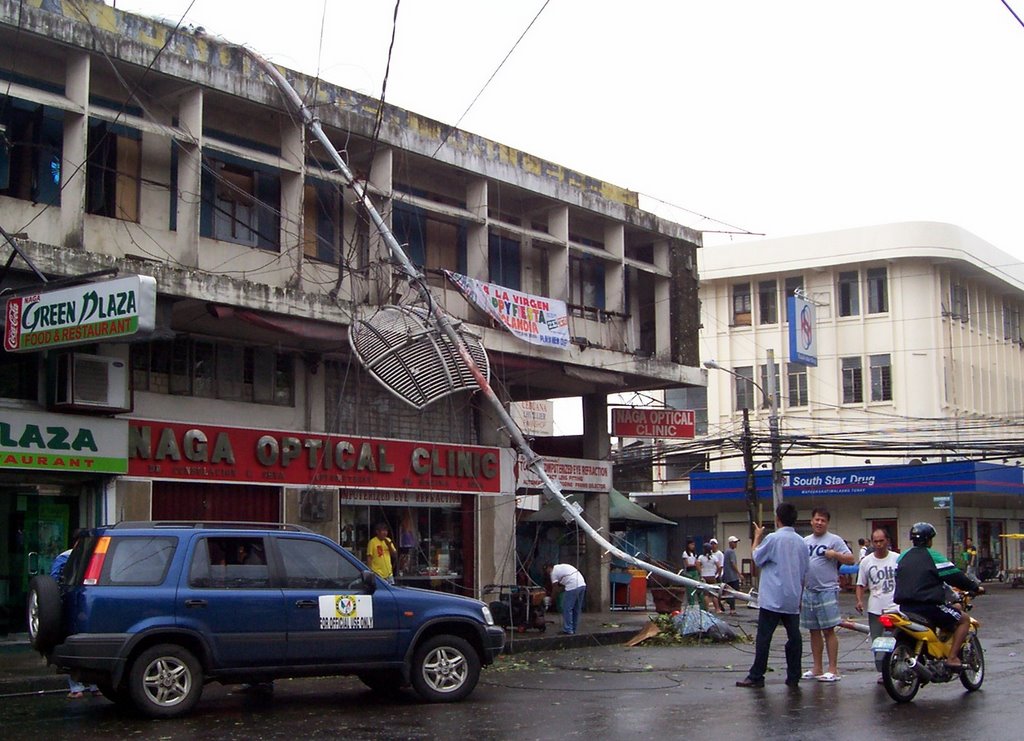
Mayor Robredo checking PT&T's fallen microwave tower. I later saw it when I did the previous post at the PT&T office.

A fallen signboard staring down Casureco II's boom truck.

The payloader of the City Engineer's Office hoisting a chainsaw-armed frontliner, taking on a fallen acacia at the Civic Center...

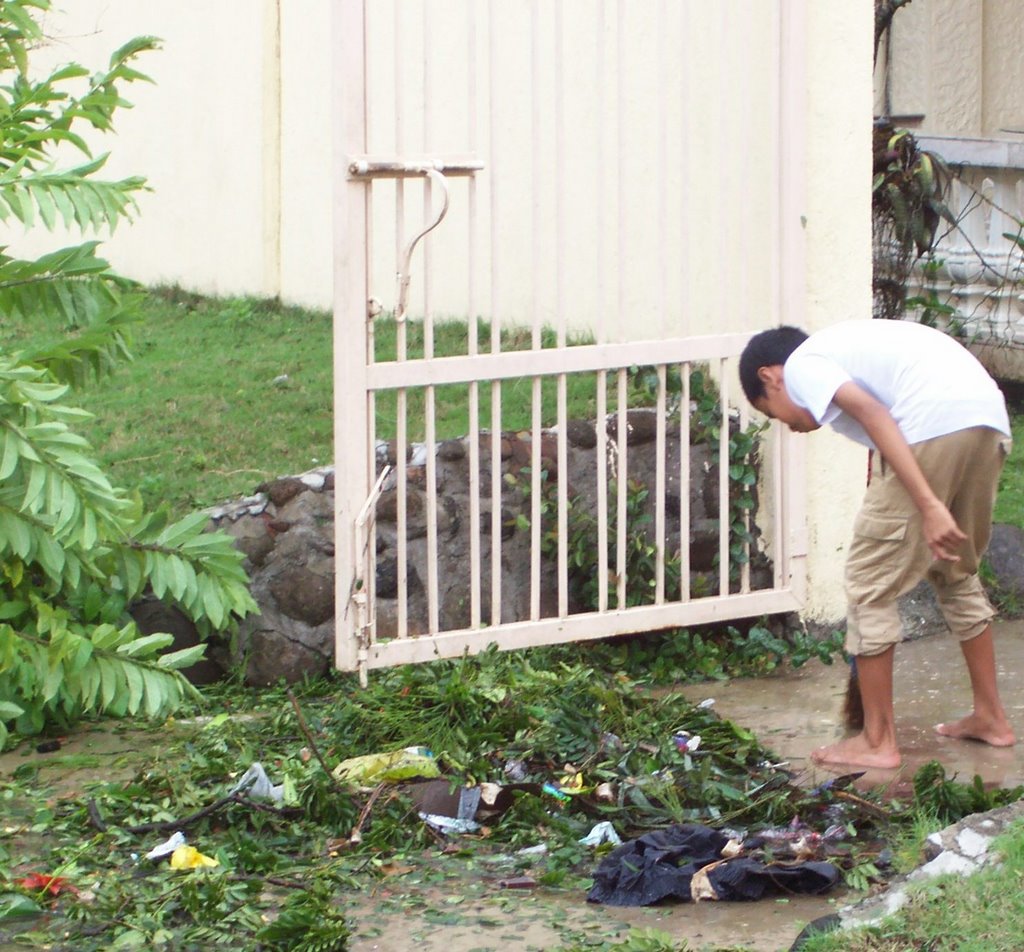
...while a youngster does his share in picking up trash that Milenyo left behind.

Bitter rivals share the same fate in the face of Milenyo's howling winds.

More...

Typhoon Milenyo: The aftermath

I WENT around the city center again looking for an 'live' internet cafe as I wasn't able to find one yesterday; fortunately, there's already one at PT&T. As far as I know, Bayantel and Digitel are still down.

Power is yet to be restored, and it is only expected to be back online tomorrow at the earliest, Mayor Jesse Robredo announced over the radio this morning. Government services, particularly garbage collection, is expected to normalize by Monday. But the city has hummed back to life. Most businesses have opened since yesterday. On the other hand, many schools, particularly at the elementary level, have decided to postpone classes to Monday instead and focus on putting things back into shape. Exceptions include Ateneo de Naga University and the Camarines National High School which resumed operations a full day after Typhoon Milenyo struck.

The city government and volunteer groups are focusing their attention today on collecting debris, mostly fallen tree branches, that residents have collected and piled up along city streets. Yesterday's efforts centered on road clearing, as trees felled by Milenyo littered the city's main and secondary roads. It was another occasion where the local community, as Filipinos are wont to do in the aftermath of calamities, came together as one.

When the winds eased up at 6 am yesterday, I tried to motor down to the
centro looking for gas. Three tree trunks blocked the wooded section of the Naga-Carolina road along Km 8. Two hours later, it was already passable, thanks to the efforts of a handful of local residents, including one who volunteered his chainsaw that speeded the cutting and chopping down of the biggest one. Oca Orozco, the city environment officer, passed us by on board his motorcycle. He had went around, he said, and told me that Sitio Caromatig had many more fallen trees blocking traffic.

Five hundred meters down the road, another old man was busily hacking at a smaller tree with his trusty bolo, knowing that life will be much easier for everyone. They did not wait for government to do the task for them.

Naga appears to have been spared of the typhoon's projected peak winds of 260 kph. According to Mike Padua's own weather station in Naga, the strongest wind gust that hit us only reached a maximum of 106 kph. Its eyewall went past by at around 11 pm, about 30 kilometers south-southwest of the city.

But the rest of the province, especially nearby Iriga City, were badly hit, according to DWNX which has been doing emergency broadcast on its own power over the last two days. As of this morning, 1 of the reported 2 casualties in Camarines Sur was from the place, the other coming from Libmanan. Today's Inquirer on the other hand said Milenyo left 8 people dead in neighboring Albay province, including 1 in Legazpi City.

More...
27 September 2006

Bracing for Typhoon Milenyo

I'M DOING this quick post while power was temporarily restored. It's been on and off since the weather started to worsen as Typhoon Milenyo (international name: Xangsane), now with wind gusts of up to 260 kilometer per hours, is poised to strike the city. When we reported for work early this morning, its maximum wind while passing through Northern Samar was only around 130 kph.

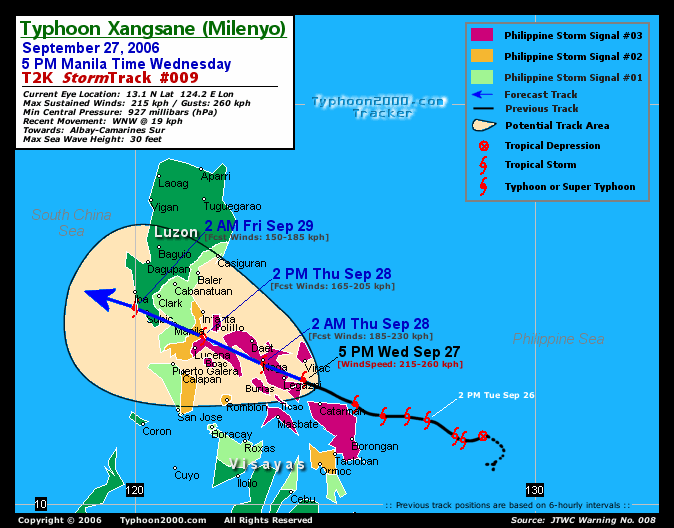
According to Mike Padua's popular typhoon tracking website, it is currently battering Albay; its eyewall is expected to be in our neighborhood from 10pm tonight until 8am tomorrow.

This popup storm update from Padua's site says the eyewall

is the ring of rain clouds surrounding the "eye" of a typhoon. It is here where the strongest winds and heaviest rain of a typhoon can be found.
The projected storm track above (nicked from the same website) was issued at 5pm today, and shows Milenyo passing through the Camarines Sur mainland tonight on its way to Metro Manila.

More...

The 1978 Naga town plan

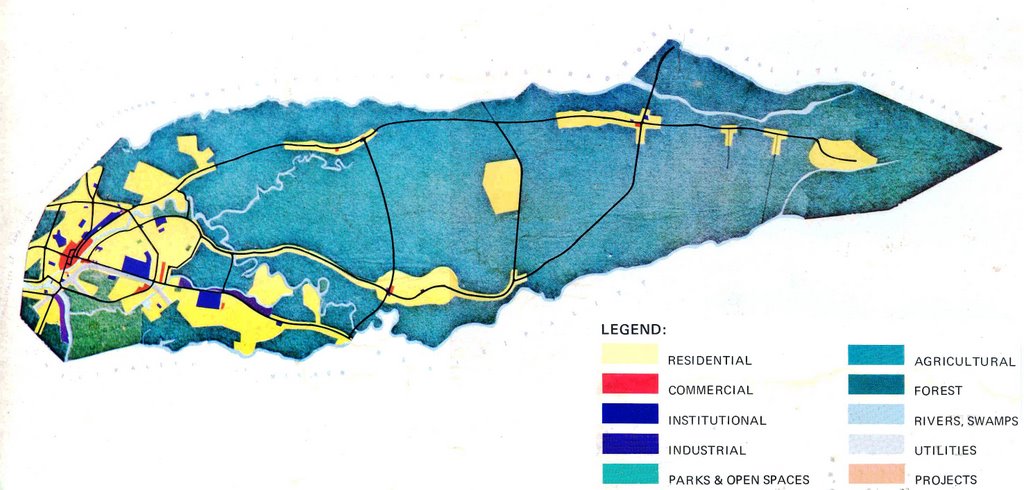
AFTER patiently explaining to Job Oliva, statistician of the city planning office, what I wanted, we finally found yesterday the information I was looking for: the 1978 town plan of the city in the form of two maps.

The maps were already in a state of decay, which does not speak well of how we handle information of high institutional, not to mention historical value. It's a picture of what the city wanted itself to be three decades ago, for chrissake!

Fortunately, technology (our HP scanner, plus Adobe Photoshop CS, Microsoft Paint and Microsoft Office Picture Manager) came to the rescue. Restoration is still a work in progress, and I'll be asking Mike, our ever dependable graphics artist, to spare some time in doing a better digital restoration effort.

But for the meantime here they are, available for comparison with the 2000 land use plan, as well as how Naga has developed spatially in the last 28 years, via Google Earth.

More...

26 September 2006

The 2006 NAT results and the realm of the possible

I WAS ready to congratulate the schools division of Southern Leyte on its feat in the 2006 National Achievement Test (NAT) upon reading this headline from the Inquirer website. Until I reached this paragraph:

According to DepEd Southern Leyte division superintendent Violeta Alocilja, the top 10 schools and their mean percentage scores (MPS) were: Sindangan Elementary Schools in Macrohon with 93.82 MPS, Tinago Elementary School in Tomas Oppus (93.16), Cambite Elementary School in Tomas Oppus (91.93), Mahalo Elementary School in Hinunangan (91.63), Carnaga Elementary School in Tomas Oppus (91.61), Tomas Oppus Central School in Tomas Oppus (91.16), Otama Elementary School in Hinunangan (91.03), Maslog Elementary School in Tomas Oppus (90.84), Laray Elementary School in Macrohon (90.13) and Cawayanan Elementary School in Bontoc (90.03).
Are scores like these in the realm of the possible? From what remains of my knowledge in statistics, test results of individual students in an average class would follow a bell-shaped curve called the normal distribution, or Gaussian distribution if you like. You can correct me on this, but applied to these schools, an average MPS of 90 will require something like half of the class getting an individual rating of 90%, the bottom quarter getting no less than 80% and the upper quarter no less than 100%.

My gut, and the five years I've spent working with public schools, tells me something is wrong here, and it is worth looking into with the same zeal shown by Secretary Jesli Lapus in going after the Palaro cheats.

More...

21 September 2006

Soft budget constraint and the IRA system

THE concept of soft budget constraint in the previous post brings to mind the 15-year old Internal Revenue Allotment (IRA) system that for most part has been financing our local governments. For the uninitiated, let me point you to this presentation by Dr. Milwida "Nene" Guevara, a former finance undersecretary and presently CEO of Synergeia Foundation, Inc.

On first glance, the SBC problem, strictly speaking, does not seem to apply to Philippine LGUs; we have yet to hear or see a local government so mired in a financial crisis that the national government had to bail it out. This is because of stringent local budgeting regulations that largely prevent LGUs from operating on a deficit.

This is where Guevara's piece comes in. Among others, it bewails the failure of most Philippine LGUs to develop their local revenue sources, particularly among provinces and municipalities. In 1990, before LGC 91 became law, locally generated monies accounted for 68% of total LGU expenditures. Starting in 1993 onwards, it dropped to 43% and it was downhill even since, with the lowest at 32% in 2001. In 2004, it eased up a bit to 38%.

And why is this so? Because of an endemic dependency on the IRA,
which is a manifestation of the SBC syndrome. The continued expectation that the IRA will increase annually in absolute amounts has bred complacency among most LGUs, to the detriment of fiscal discipline and efficient governance. This is particularly pronounced among provinces (83% of whose income are derived from national transfers) and municipalities (78%). Cities, by comparison, depend on such transfers up to 45% of their income.

This behavior is inconsistent with local autonomy. Quoting Dr. Paul Bernd Spahn, a visiting professor of public finance at the Johann Wolfgang Goethe University in Frankfurt, Peryodistang Pinay has this to say:

Local authorities, for their part, need to shake off a “grants dependency” on the central government and make the most of available options—like taxation powers—to prove they are ready for the responsibilities of autonomy.
Come to think of it: is not the current performance-neutral IRA system one gigantic bailout facility that props up most Philippine LGUs today?

More...

Soft budget constraint

IT'S WELL into the budget season among local governments. By this time, budget departments of Philippine LGUs should be neckdeep in preparing their proposed spending program for 2007. Section 318 of the Local Government Code of 1991 (LGC 91) provides that local chief executives should submit this to their respective sanggunians no later than October 16.

Six days earlier, the country will mark the 15th anniversary of LGC 91. One of the many failings of Congress ever since is its inability to complete and effect a mandatory review of the code (at least once every 5 years, so that's a minimum of 3) as required under Section 521. This post by Peryodistang Pinay reminded me of it, as well as the concept of soft budget constraint (SBC).

Janos Kornai, a Hungarian economist, coined the term to describe the opportunistic behavior of state-owned enterprises in communist countries to continue operating on a loss because the state is expected anyway to bail them out of financial trouble. While more apparent in socialist systems, this phenomenon also appears in mixed economies, including the US where floundering public and private enterprises have been bailed out in the past.

More...

20 September 2006

Creative destruction and our languages

I FIRST encountered the concept of "creative destruction" in our urban economics module two years back. While researching on soft budget constraint in preparing my principal's position paper on the Internal Revenue Allotment (IRA), I met it again.

According to Wikipedia

Creative destruction, introduced in 1942 by the economist Joseph Schumpeter, describes the process of industrial transformation that accompanies radical innovation. In Schumpeter's vision of capitalism, innovative entry by entrepreneurs was the force that sustained long-term economic growth, even as it destroyed the value of established companies that enjoyed some degree of monopoly power.
I see this concept behind the ongoing evolution of two languages closest to my heart, Bikolano and Filipino. The pace varies, but both these tongues are evolving.

Take for instance Kristian Cordero's take on the politics of writing in Bikol. The piece touches on the unresolved struggle between purists who want to maintain its original iberian moorings and the pragmatists, like Cordero and myself, who see language as a dynamic, living entity. This is set in the context of a renaissance in Bikol literature which Frank Peñones told me about, ushered in by the growing influence of Rinconada:
"duman sa kun an mga tawo magtaram garo mga gamgam,"* to borrow Cordero's words.

Or take the 55 comments, and growing, on VegasFilAmGuy's post inspired by Irvin. Sto Tomas' weblog
on Filipinization arising from the 2001 revision of the Filipino alphabet and spelling. I was disoriented by this five-year old policy myself, and so is Grace from our Planet Naga blog aggregator. But while I am not happy with this policy, we should not miss trees for the forest: creative destruction is well underway in these two languages.

---------------
*Where the people speak like birds

More...

18 September 2006

I'm ready to migrate

UPDATE (11:31am, 19 Sept): The migration process is complete. My old template will soon fade into memory. But if things go wrong, it's just a command away.:)

TWENTY posts and two weeks after launching my test blog, I have created a superior three-column template for this weblog, based on Jason Sutter's Jellyfish. (See screenshot.)

That test blog (as can be seen from its subtitle) is intended to see if Blogger Beta can live up to its hype. My conclusion: it can, even in the hands of an HTML tyro like me. In those 14 days, I learned some tricks about cascading style sheets (CSS), enough to create that template, aided mostly by the good ol' trial-and-error approach made painless by the "Preview" and "Clear Edits" function in Blogger Beta.

The new template now has the capability to do post categories, powered by the new Labels function under Blogger Beta. It has some visually appealing bells and whistles I discovered and implemented along the way: a colored background for quotes (which now have more generous space around them); a more understated dotted blue line beneath hyperlinks instead of the regular straight line, and the same color background when the mouse pointer hovers above them; post titles that are underlined and color highlighted when hovered about; and a dotted gray line separating the body text from the footer.


Boxing these, of course, is the neater, two-sidebar layout where my links occupy the left while the rest of my chosen page elements (the "About Me" text block, the "Recently" list of posts through site feed, my Categories, Archives and a javascript link for Technocrati) are lined up, right-justified, to the right.

Who says an old dog can't learn new tricks? :)

More...